The 2021 Writing Series is a series of daily writing exercises for both prose writers and poets to keep their creative mind stretched and ready to go—fresh for your other writing endeavors. The writing prompts take the impetus—that initial crystal of creation—out of your hands (for the most part) and changes your writing creation into creative problem solving. Instead of being preoccupied with the question "What do I write" you are instead pondering "How do I make this work?" And in the process you are producing new writing.
This is not a standard writing session. This is pure production—to keep your brain thinking about using language to solve simple or complex problems. The worst thing you can do is sit there inactive. It's like taking a 5 minute breather in the middle of a spin class—the point is to push, to produce something, however imperfect. If you don't overthink it, you will be able to complete all of the exercises in under 30 minutes.
#74 Dueling Six Word Shootout 8
For today's writing exercise write a piece that includes one or both of the following sets of 6 words. Don't front-load them all into the beginning of your piece, save at least one or two for somewhere to 'aim' your piece. Remember sestinas have 6 different end-words, but don't let me tell you what to write. Just use all 6 (or twelve) words in a fashion that isn't throw-away. Don't put them in in a way that you'll definitely later edit them out because they don't add to the piece. Make them important. This might require a little brainstorming at first. Don't be afraid, you can do it!
Set 1:
1) Forage
2) Scourge
3) Lurch
4) Earthen
5) Plinth
6) Bin
Set 2:
7) Goat
8) Evoked
9) Bone
10) Orange
11) Fin
12) Bolt
--- Bonus Exercise: If that's not enough, also include the following three things: A Pond, A Hatchet (or ax) and Toast.
------------------------------------
If you'd like some background music to write to, try jazz pianist Ahmad Jamal's 1958 live album "Complete Spotlite".
The 2021 Writing Series is a series of daily writing exercises for both prose writers and poets to keep their creative mind stretched and ready to go—fresh for your other writing endeavors. The writing prompts take the impetus—that initial crystal of creation—out of your hands (for the most part) and changes your writing creation into creative problem solving. Instead of being preoccupied with the question "What do I write" you are instead pondering "How do I make this work?" And in the process you are producing new writing.
This is not a standard writing session. This is pure production—to keep your brain thinking about using language to solve simple or complex problems. The worst thing you can do is sit there inactive. It's like taking a 5 minute breather in the middle of a spin class—the point is to push, to produce something, however imperfect. If you don't overthink it, you will be able to complete all of the exercises in under 30 minutes.
#73
Beginning, Middle & End 8
For today's writing exercise you will write a piece of poetry or prose which begins with one image, scenario, line of dialog or place, includes another thing or event somewhere beyond the first and before the last stanza/paragraph, and ends with another required 'thing'.
Begin With: Someone falling off a shed (or garage).
Somewhere in the middle: A woodpecker makes a racket.
End With: The smell of fresh popcorn. Extra Credit Requirements: Your title must be exactly 6 words long and you must include an open flame (candle, bonfire, cooking fire, lighter, match etc).
------------------------------------
If you'd like some unobtrusive background music try the 1962 album "Undercurrent" by Bill Evans and Jim Hall.
The 2021 Writing Series is a series of daily writing exercises for both prose writers and poets to keep their creative mind stretched and ready to go—fresh for your other writing endeavors. The writing prompts take the impetus—that initial crystal of creation—out of your hands (for the most part) and changes your writing creation into creative problem solving. Instead of being preoccupied with the question "What do I write" you are instead pondering "How do I make this work?" And in the process you are producing new writing.
This is not a standard writing session. This is pure production—to keep your brain thinking about using language to solve simple or complex problems. The worst thing you can do is sit there inactive. It's like taking a 5 minute breather in the middle of a spin class—the point is to push, to produce something, however imperfect. If you don't overthink it, you will be able to complete all of the exercises in under 30 minutes.
#72
Ekphrastic Fantastic 7
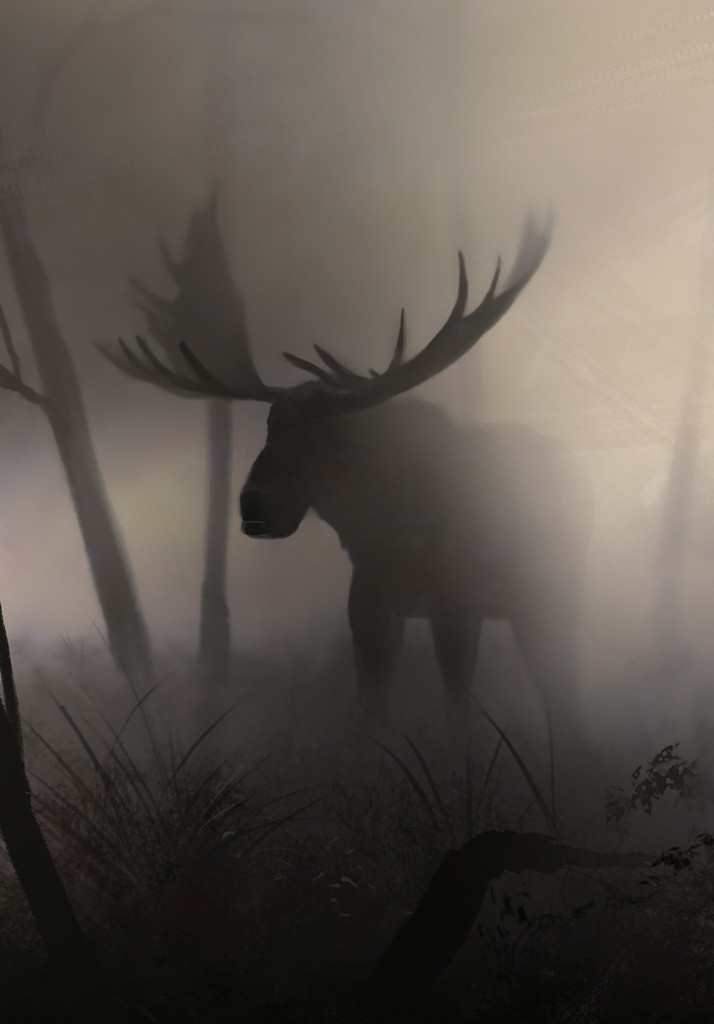
For today, we're pairing images for you to respond to. The two images will be contrasting and it will be up to you how they can interact, how your writing can make the two pieces of art meet. Or, just pick one of the images and run with it if you'd rather. I'm not here to tell you exactly what to do, just to help you get the ball rolling. But if it was me, I would look for commonalities or how one image could be an imagination or memory or media within the other image, or if they exist in the same 'world', how you can get from one point in space and time to the other. But you do you boo-boo.
Image 1: This photo by an unknown photographer of abandoned escalators.
Image 2: This untitled moose digital painting by artistRenaud Perochon.
-----
How do these two images play off of each other in your mind? Are you going from one to the other or do they intermingle in your piece? There is moody lighting in both, but are they nearby in proximity, or does the abandoned 'man-made' juxtapose against the hazy moose painting in a purely metaphorical manner? Something completely different? You decide. Don't overthink it, take a couple minutes perhaps, but dive in and make this happen!
You got this!
-----
If you'd like background writing music, let's go with this "Just Imagine" minimalist lofi playlist.
The 2021 Writing Series is a series of daily writing exercises for both prose writers and poets to keep their creative mind stretched and ready to go—fresh for your other writing endeavors. The writing prompts take the impetus—that initial crystal of creation—out of your hands (for the most part) and changes your writing creation into creative problem solving. Instead of being preoccupied with the question "What do I write" you are instead pondering "How do I make this work?" And in the process you are producing new writing.
This is not a standard writing session. This is pure production—to keep your brain thinking about using language to solve simple or complex problems. The worst thing you can do is sit there inactive. It's like taking a 5 minute breather in the middle of a spin class—the point is to push, to produce something, however imperfect. If you don't overthink it, you will be able to complete all of the exercises in under 30 minutes.
#71
Erasing EAP "The Premature Burial" 7
For today's exercise we have split paths for fiction and poetry, though I highly recommend that even fiction writers try the poetry exercise, because erasures can be a blast!
Edgar Allen Poe is considered by some to be the writer that solidified the short story genre as, well, a genre. Not the first writer of short stories, or even popular short stories, but he wrote enough of them that with the stories of Nathaniel Hawthorne, Charles Dickens, Irving Washington and others, critics were finally like—fine. Short stories can be a thing.
An Erasure/Blackout is really simple: you take the given text and remove many words to make it your own new piece. One way to go about the erasure that I like to do is to copy the text and paste it twice into your document before you start erasing or blacking out (in MS Word set the text background color to black), that way if you get further into the erasure and decide you want a somewhat different tone or direction, it's easy to go to the unaltered version and make the erasure/black-out piece smoother. Another tip is to look for recurring words, or themes.
If you insist on fiction (or if one of these strikes you), write a piece with one of these titles taken from this section:
A Torpid Uneasiness
Quiescence
Utter Raylessness
Amid All My Infinite Miseries
Wrists for the Bell-Rope
Some Ordinary and Nameless Gave
A Partial and Evanescent Success
Erasure Selection:
from "The Premature Burial"
There arrived an epoch -- as often before there had arrived -- in which I found myself emerging from total unconsciousness into the first feeble and indefinite sense of existence. Slowly -- with a tortoise gradation -- approached the faint gray dawn of the psychal day. A torpid uneasiness. An apathetic endurance of dull pain. No care -- no hope -- no effort. Then, after a long interval, a ringing in the ears; then, after a lapse still longer, a prickling or tingling sensation in the extremities; then a seemingly eternal period of pleasurable quiescence, during which the awakening feelings are struggling into thought; then a brief re-sinking into non-entity; then a sudden recovery. At length the slight quivering of an eyelid, and immediately thereupon, an electric shock of a terror, deadly and indefinite, which sends the blood in torrents from the temples to the heart. And now the first positive effort to think. And now the first endeavor to remember. And now a partial and evanescent success. And now the memory has so far regained its dominion, that, in some measure, I am cognizant of my state. I feel that I am not awaking from ordinary sleep. I recollect that I have been subject to catalepsy. And now, at last, as if by the rush of an ocean, my shuddering spirit is overwhelmed by the one grim Danger -- by the one spectral and ever-prevalent idea.
For some minutes after this fancy possessed me, I remained without motion. And why? I could not summon courage to move. I dared not make the effort which was to satisfy me of my fate -- and yet there was something at my heart which whispered me it was sure. Despair -- such as no other species of wretchedness ever calls into being -- despair alone urged me, after long irresolution, to uplift the heavy lids of my eyes. I uplifted them. It was dark -- all dark. I knew that the fit was over. I knew that the crisis of my disorder had long passed. I knew that I had now fully recovered the use of my visual faculties -- and yet it was dark -- all dark -- the intense and utter raylessness of the Night that endureth for evermore.
I endeavored to shriek-, and my lips and my parched tongue moved convulsively together in the attempt -- but no voice issued from the cavernous lungs, which oppressed as if by the weight of some incumbent mountain, gasped and palpitated, with the heart, at every elaborate and struggling inspiration.
The movement of the jaws, in this effort to cry aloud, showed me that they were bound up, as is usual with the dead. I felt, too, that I lay upon some hard substance, and by something similar my sides were, also, closely compressed. So far, I had not ventured to stir any of my limbs -- but now I violently threw up my arms, which had been lying at length, with the wrists crossed. They struck a solid wooden substance, which extended above my person at an elevation of not more than six inches from my face. I could no longer doubt that I reposed within a coffin at last.
And now, amid all my infinite miseries, came sweetly the cherub Hope -- for I thought of my precautions. I writhed, and made spasmodic exertions to force open the lid: it would not move. I felt my wrists for the bell-rope: it was not to be found. And now the Comforter fled for ever, and a still sterner Despair reigned triumphant; for I could not help perceiving the absence of the paddings which I had so carefully prepared -- and then, too, there came suddenly to my nostrils the strong peculiar odor of moist earth. The conclusion was irresistible. I was not within the vault. I had fallen into a trance while absent from home-while among strangers -- when, or how, I could not remember -- and it was they who had buried me as a dog -- nailed up in some common coffin -- and thrust deep, deep, and for ever, into some ordinary and nameless grave.
------------------------------------
As your background music sommelier I've chosen Vangelis to pair with your "Erasing The Premature Burial" series. For this sampling I've selected the "Hypothesis", Vangelis' 1978 album.
The 2021 Writing Series is a series of daily writing exercises for both prose writers and poets to keep their creative mind stretched and ready to go—fresh for your other writing endeavors. The writing prompts take the impetus—that initial crystal of creation—out of your hands (for the most part) and changes your writing creation into creative problem solving. Instead of being preoccupied with the question "What do I write" you are instead pondering "How do I make this work?" And in the process you are producing new writing.
This is not a standard writing session. This is pure production—to keep your brain thinking about using language to solve simple or complex problems. The worst thing you can do is sit there inactive. It's like taking a 5 minute breather in the middle of a spin class—the point is to push, to produce something, however imperfect. If you don't overthink it, you will be able to complete all of the exercises in under 30 minutes.
#70 Between a Fact and an Exact Place 5
For today's writing exercise you will write a piece of poetry or prose which contains the following place (either as the setting, referenced or some aspect of it described) and the following fact in some way (its discovery, used as a metaphor, witnessed etc).
It's Wednesday, so you know what that means! HUMP DAY SUBMISSIONS! Because it's easy to fall off the submission train during the week I'm presenting you with 3 cool and very different small journals currently open for submissions to save you research time! Pick one of the three journals presented and read some of the pieces in your genre. If you're not digging them, check the next journal. Don't agonize over it, if you're not enjoying the writing or you don't feel your writing would fit in there move along to the next journal. If none of them seem to fit... maybe next week?
Journal 1: Ghost City Review. This (mostly) monthly online journal out of Syracuse, NY, reads no fee submissions in all genres via email. Check out their interview with Entropy Mag from 2017 here. But mainly, as always read the newest issue to get a feel for their aesthetic which is eclectic but (in my experience) it leans a bit on the interesting/innovative side over the accessible side.
"Ghost City Review welcomes submissions of poems, short stories, flash fiction, personal essays, adventure narratives, journal entries, short plays, monologues, translations, photographs, oil paintings, watercolors, sculptures, dioramas…. pretty much anything you can think of. We want to see it all. Show us what you’ve created."
The 2021 Writing Series is a series of daily writing exercises for both prose writers and poets to keep their creative mind stretched and ready to go—fresh for your other writing endeavors. The writing prompts take the impetus—that initial crystal of creation—out of your hands (for the most part) and changes your writing creation into creative problem solving. Instead of being preoccupied with the question "What do I write" you are instead pondering "How do I make this work?" And in the process you are producing new writing.
This is not a standard writing session. This is pure production—to keep your brain thinking about using language to solve simple or complex problems. The worst thing you can do is sit there inactive. It's like taking a 5 minute breather in the middle of a spin class—the point is to push, to produce something, however imperfect. If you don't overthink it, you will be able to complete all of the exercises in under 30 minutes.
#69
Title Mania "Topography"8
For today's writing exercise you will write a piece of poetry or prose that utilizes one of the following titles, and if you want extra 'bonus points' also include the three items from below the title list. All of today's poems come from the wonderful poem "Topography" by Sharon Olds.
Titles:
Our Bodies
Delicately Together
Moon Rising Slowly
All Four Bodies of the Sky
All Our States United
Your Fire Island
Bonus Exercise: Three Things
(Your piece must also include the following three 'things', if you choose this option)
The 2021 Writing Series is a series of daily writing exercises for both prose writers and poets to keep their creative mind stretched and ready to go—fresh for your other writing endeavors. The writing prompts take the impetus—that initial crystal of creation—out of your hands (for the most part) and changes your writing creation into creative problem solving. Instead of being preoccupied with the question "What do I write" you are instead pondering "How do I make this work?" And in the process you are producing new writing.
This is not a standard writing session. This is pure production—to keep your brain thinking about using language to solve simple or complex problems. The worst thing you can do is sit there inactive. It's like taking a 5 minute breather in the middle of a spin class—the point is to push, to produce something, however imperfect. If you don't overthink it, you will be able to complete all of the exercises in under 30 minutes.
#68
How to... 3
For today's prompt we are focusing on imperative directional pieces. What does that mean? A "How to"! You don't have to title your piece "How to ..." (though you certainly can if you'd like to), you could write a prose piece that merely includes someone giving another directions or you could make it a step by step process like a recipe, however you want to interpret the prompt, the process that is the 'how to' should merely be described at some length during your piece, in some fashion.
The 2021 Writing Series is a series of daily writing exercises for both prose writers and poets to keep their creative mind stretched and ready to go—fresh for your other writing endeavors. The writing prompts take the impetus—that initial crystal of creation—out of your hands (for the most part) and changes your writing creation into creative problem solving. Instead of being preoccupied with the question "What do I write" you are instead pondering "How do I make this work?" And in the process you are producing new writing.
This is not a standard writing session. This is pure production—to keep your brain thinking about using language to solve simple or complex problems. The worst thing you can do is sit there inactive. It's like taking a 5 minute breather in the middle of a spin class—the point is to push, to produce something, however imperfect. If you don't overthink it, you will be able to complete all of the exercises in under 35 minutes.
#67 Sentence Calisthenics 4
For today's writing exercise complete the following steps for a specific period of time, using the timer on your phone or computer and setting it for 5 minutes for each 'set'. The point here is to produce at very least 6 sentences in each set, but you're looking for both quality and quantity. Don't write a bunch of sentences with the same construction or that are boring—it's better if you have no idea how in the heck you might use the sentence. Something funky, interesting. Normal, well-phrased sentences are of course good to have in the mix too, but include some quirky ones in each set.
At the end of every set mark your favorite 1-2 sentences.
In order to complete the large number of sentences demanded of this exercise it is imperative that you write fast. Don't stop to think too much at all until you've reached the final exercise. The process of this quick production is to thrust past second guesses or other stumbling blocks that sometimes impede your writing. You're aiming to write 30 individual, unlinked sentences in 25 minutes so you have ten minutes to organize and write that actual piece using the 'round up' prompt. This means you're going to be writing more than a sentence a minute. You can't do that if you're dawdling or trying to figure out the 'perfect' phrasing. The first couple times writing to these sprint-style prompts you may barely squeak the lines out in time, but as you get more used to it you'll get more both in quantity and in quality of your sentences.
Save all of your sentences to a "Sentence Calisthenics" document, if you participate for awhile we'll have some bonus exercises that will refer back to these sentences, because sometimes you can't see the gold hiding in plain sight when you've just written something. Having fresh eyes might result in a quick, awesome piece. So, save those sentences!
WRITE FAST, DON'T OVERTHINK
Getting into the mindset: Before you start your timer, take a moment and breathe and think about keeping cool during a very hot day (and also during hot nights). Think about the feeling of a hot night, trying to sleep when sweating/covered in sweat or however else you experience a hot night or day. Think both humid and dry heat. Keep thinking of these things in the back of your mind as you're writing and in between sets. By no means should all of your sentences revolve around these things, we just want your mind centered with a few anchors in place before we charge into our piece, DON'T LET THIS DISTRACT YOU FROM YOUR SENTENCES. When you feel set, read the set instructions, appropriate Wordbank, and start that timer.
When the timer goes off move on to the next set regardless of if you met the 6 sentence goal, you wrote only 3, or 12—when the timer rings, move along and if you don't hit 6 for one set, do your dangedest to knock out 6 in the next set even if some of them are short or silly or straightforward or even a fragment.
Set 1: Using the first word bank write six (6) or more sentences which include one of the words and a non-primary color.
Wordbank 1:
Slick
Fan
Particle
Scorching
Spring
Set 2: Now write six (6) or more sentences which use two words from that first bank. At least two (2) of the sentences must be fewer than six words. Remember to mark 1-2 favorites for each set.
Wordbank 2:
Thrilled
Shrill
Wilted
Onion
Dust
Set 3: In preparation of the next six (6) or more sentences you should first pick two words Wordbank 1 and type/write them out. Each of your sentences for this 5 minutes must include one of those two pre-selected words and one of the words from Wordbank 2.
Set 4: Now take a minute to look through this list of texture descriptions and write down 3-5 of them. Write at least six (6) sentences which include two words from Wordbank 2 and one of those textures. You're marking 1-2 favorites, right? Keep doing it.
Wordbank 3:
Bolt
Bucket
Exit
Jug
Lumpy
Set 5: Take just 3 minutes now to write as many sentences that use at least two of the words from Wordbank 3
Set 6: Now write six (6) sentences that include one word from each of the three wordbanks.
The Round-up
1) Gather up all of your marked favorite lines and pick from those favorites at least three sentences to build your piece around.
2) Now that you know the core of your piece, go back up to the un-favorite lines and pick three additional sentences that you must use (even if you 'spruce' them up by tightening or quirking up the language).
3) Now you have 6 sentences that are unconnected. You have a large chunk of a jigsaw puzzle but you've lost all the rest of the pieces. So it's time to make those pieces yourself. Make sure your piece has a 'point' or some sort of larger meaning above just the literal narrative/descriptions. Make an observation for better or worse, large, small or teensy tiny even. But, something new, and unique to your brain.
4)OPTIONAL COMPLETE-A-PIECE. If your piece hasn't jumped right out at you, use this 'formula'. First, throw out three of those six sentences that you don't care for as much. Now write a piece which is broken roughly into 1/3s with the first 1/3 including one of your sentences and briefly recalling (or inventing) a night in which the heat is overwhelming, making it impossible to sleep, be sure to use lots of concrete details, and don't describe things with the first way that comes to mind—"Tell it slant". The second 1/3 should include 1-2 of your sentences and either an actual adventure out into the late night heatwave world, or an imagined one (imagined even within the world of the piece perhaps, ie fantasy/imagination). Before moving onto the last section of the piece take a quick look back at your starred list of sentences and see if there's any that would fit in your piece. You want to use this as a little scaffolding for the final chunk, but if you don't find one or two that fit that is fine too. The third 1/3 should return to your narrator's past (at least ten years prior to the sleepless night) thinking very briefly of another two times in which they had gotten especially hot/sweaty (ideally non-sexual, but this is your piece, if something sexual fits, go for it), then returning to the sleepless night, describing something seen in the room with the narrator that is 'still', almost like ending on a still life, but also giving the piece a sense of calm. And that's it. You have your piece. This will definitely take longer than ten minutes but may just be worth it.
------------------------------------
Want some unobtrusive background writing music? Try "Stone Flower", the sixth studio album from Brazilian Antônio Carlos Jobim, the 'father of Bossa Nova'.
The 2021 Writing Series is a series of daily writing exercises for both prose writers and poets to keep their creative mind stretched and ready to go—fresh for your other writing endeavors. The writing prompts take the impetus—that initial crystal of creation—out of your hands (for the most part) and changes your writing creation into creative problem solving. Instead of being preoccupied with the question "What do I write" you are instead pondering "How do I make this work?" And in the process you are producing new writing.
This is not a standard writing session. This is pure production—to keep your brain thinking about using language to solve simple or complex problems. The worst thing you can do is sit there inactive. It's like taking a 5 minute breather in the middle of a spin class—the point is to push, to produce something, however imperfect. If you don't overthink it, you will be able to complete all of the exercises in under 30 minutes.
#66
Three Things, Five Words 8
For today's writing exercise you will write a piece of poetry or prose which contains the following three things, and these five individual words. The three things should be important to the piece, not just a throwaway reference used because it has to be. This is prompt time, baby!
If you're not sure where to start, begin by finding a connection between two of the 'things'—whether that is a shared appearance, locale, one of the things might interact with another (or all three), some way that the two are likened or could be physically together. Use one of the things with two of the 'words' in the beginning of the piece and explore for a bit, knowing that you're aiming at the second ''thing' (where the two 'things' have their connection) about 1/3-1/2 of the way through what you imagine the length of the piece (which may be totally off). By then you should have a direction and it's off to the races, with that third 'thing' in your pathway to the finishing line.
'Three Things'
A Pig
A Sewing Machine
Copper
'Five Words'
Include these five words in your piece:
Bolted, Drag, Flew, Wafer, Dill.
-----
If you'd like some background music to write to, try jazz saxophonist Stan Getz's album "Cool Sound of Stan Getz" (1958).
The 2021 Writing Series is a series of daily writing exercises for both prose writers and poets to keep their creative mind stretched and ready to go—fresh for your other writing endeavors. The writing prompts take the impetus—that initial crystal of creation—out of your hands (for the most part) and changes your writing creation into creative problem solving. Instead of being preoccupied with the question "What do I write" you are instead pondering "How do I make this work?" And in the process you are producing new writing.
This is not a standard writing session. This is pure production—to keep your brain thinking about using language to solve simple or complex problems. The worst thing you can do is sit there inactive. It's like taking a 5 minute breather in the middle of a spin class—the point is to push, to produce something, however imperfect. If you don't overthink it, you will be able to complete all of the exercises in under 30 minutes.
#65 Erasing Roger Ebert 23 "Wholly Moses"
For today's exercise we have split paths for fiction and poetry, though I highly recommend that even fiction writers try the poetry exercise, because erasures can be a blast!
Roger Ebert has been the archetypal film critic for decades, and he's written thousands of reviews. Because of their nature, almost their own bit of ekphrastic art, this series of erasures will be lots of fun!
An Erasure/Blackout is really simple: you take the given text and remove many words to make it your own new piece. One way to go about the erasure that I like to do is to copy the text and paste it twice into your document before you start erasing or blacking out (in MS Word set the text background color to black), that way if you get further into the erasure and decide you want a somewhat different tone or direction, it's easy to go to the unaltered version and make the erasure/black-out piece smoother. Another tip is to look for recurring words, in this example 'bingo' occurs multiple times and could be a good touchstone for your piece.
Fiction or (poetry): If you insist on fiction (or just feel like writing a "Title Mania" piece), write a piece with one of these titles taken from this section:
Slightly Scandalized
A Fashionable Daring
Out of Sympathy, No Doubt
Aphrodisiac Peddler
Manfully
From the Bottom of a Well
Erasure Selection:
Roger Ebert's review of "Wholly Moses!"
One of the things that makes "Saturday Night Live" funny is that it's on television, so we're supposed to be slightly scandalized by its irreverence. It takes on sex, religion and politics, subjects that were out of bounds during TV's early years, and so cloaks itself in a fashionable daring. We laugh at some of the stuff not so much because it's funny as because it's on TV at all.
Proof of this is a very bad new comedy named "Wholly Moses!" which is the first feature film by "Saturday Night" director Gary Weis. The movie depends for its effect on the kind of shock value the TV show has, and it seems to he under the impression that that's enough. It kids the Old Testament, it has angels with wings that fall off, its narrator says things like "He sat her upon her ass," and we're expected to laugh.
I didn't. The movie's not funny on its own, and since movie audiences are scarcely going to be shocked by its mild but relentlessly repetitive irreverence, it all boils down to a very old joke. The screenplay is third-rate college humor, a "satire" that doesn't dare really satirize its alleged source, a newly discovered Dead Sea scroll, since the audience might not have heard of the Dead Sea scrolls, and so tries for laughs instead with one of the oldest gimmicks in the book: dressing people up in Biblical costume and having them speak in contemporary terms.
To this old wheeze has been added another one, the inspiration of casting all the minor rules with comic actors we'll recognize from other movies. The cast stars Dudley Moore and includes James Coco, Paul Sand, Richard Pryor, Jack Gilford, Dom DeLuise, Madeline Kahn, John Ritter and John Houseman, and it is a commentary on the film that none of them are particularly funny, although the audience did applaud Pryor, out of sympathy, no doubt.
Maybe Weis doesn't know that comic actors, even good ones, are rarely funny in and of themselves. They need characters to play, and they need funny material. "Wholly Moses!" doesn't have it. Example: Madeline Kahn plays an itinerant aphrodisiac peddler. She gives Dudley Moore a lift in her cart, he guzzles some of her patent aphrodisiacs and begins to get fresh, and she pushes him out of the cart. That's it. But the movie finds it necessary to supply two shots of the sign painted on her cart, so we'll remember she sells aphrodisiacs and get the joke. This movie was made either by or for very stupid people, or both.
One measurement of its failure is Dudley Moore's hapless performance in the lead. Moore is a very funny actor, something he has proven not only in his big hit comedy "10" but also in thousands of stage appearances with his sometime sidekick Peter Cook, and in a wonderful but half-forgotten 1968 comedy named "Bedazzled." Here he's totally at a loss.
The movie is told in flashback, and he plays both a tourist who stumbles across some hitherto undiscovered Dead Sea scrolls, and the hero of the scrolls. The scrolls are about Hershel, a baby boy whose tiny boat of rushes was floated onto the Nile at the same time as Moses', but who had the misfortune to be just a little bit further upstream all of his life. Moses gets the glory, and Hershel forever finds himself trying to put out the fire in the burning bush. If the idea here sounds familiar, maybe that's because it's parallel to Monty Python's more accomplished (and more successfully shocking) "Life of Brian."
Moore marches manfully through the script, but the movie sabotages all the performances with a sound track that sounds phoned in from the bottom of a well, and with editing so inept that Moore's big scene with Pryor has backgrounds that don't match from shot to shot. Nor are Pryor and Moore in the same shot for most of the scene, which looks as if Pryor was encouraged to do his schtick and then reaction shots of Moore were edited in afterward. The whole movie's like that: It feels like a series of "guest star" cameo appearances on a TV show we wouldn't want to see in the first place.
------------------------------------
If you'd like some background music, try this "Calm Your Anxiety" lofi mix.
The 2021 Writing Series is a series of daily writing exercises for both prose writers and poets to keep their creative mind stretched and ready to go—fresh for your other writing endeavors. The writing prompts take the impetus—that initial crystal of creation—out of your hands (for the most part) and changes your writing creation into creative problem solving. Instead of being preoccupied with the question "What do I write" you are instead pondering "How do I make this work?" And in the process you are producing new writing.
This is not a standard writing session. This is pure production—to keep your brain thinking about using language to solve simple or complex problems. The worst thing you can do is sit there inactive. It's like taking a 5 minute breather in the middle of a spin class—the point is to push, to produce something, however imperfect. If you don't overthink it, you will be able to complete all of the exercises in under 30 minutes.
#64
Lucky for Us Anaphora—Repetition Files 1
For today's writing exercise you will write a piece of poetry or prose which focuses on repetition. In this instance we will work with anaphora. It's a handy little bit of poetic craft that goes a little something like this:
the repetition of a word or words at the beginning of successive phrases, clauses, or lines to create a sonic effect.
Take a moment and read the above-linked Poetry Foundation article, even if you know the term. For even more fun check out this longer article called Adventures in Anaphora.
Your mission is to use the following phrase to begin at least 4 sentences.
The word or phrase we'll use for our exercise today is:
"Lucky for us..."
There are a number of ways you could approach this bit of anaphora—is the 'luck' genuine or sarcastic? Both? Is the piece going to unfold in a linear fashion or will details be revealed out of order in order to build a certain tension or to garner movement? Is four enough repetition or should you use it like ten times? Maybe 'us' won't be the same each time and sometimes you'll see "Lucky for him" or "Lucky for them"... Just be sure that the repeated phrase earns its worth in your piece, and it should in some way build upon what came before it. The repetition should be necessary and not merely redundant.
Bonus Exercise:Include these five words into your piece "Niceties" "Emerald" "Bunt" "Belt" and "Mosaic".
------------------------------------
If you'd like some background music to write to, try this "Residual Warmth" lofi mix..
The 2021 Writing Series is a series of daily writing exercises for both prose writers and poets to keep their creative mind stretched and ready to go—fresh for your other writing endeavors. The writing prompts take the impetus—that initial crystal of creation—out of your hands (for the most part) and changes your writing creation into creative problem solving. Instead of being preoccupied with the question "What do I write" you are instead pondering "How do I make this work?" And in the process you are producing new writing.
This is not a standard writing session. This is pure production—to keep your brain thinking about using language to solve simple or complex problems. The worst thing you can do is sit there inactive. It's like taking a 5 minute breather in the middle of a spin class—the point is to push, to produce something, however imperfect. If you don't overthink it, you will be able to complete all of the exercises in under 30 minutes.
#63 Dueling Six Word Shootout 7
For today's writing exercise write a piece that includes one or both of the following sets of 6 words. Don't front-load them all into the beginning of your piece, save at least one or two for somewhere to 'aim' your piece. Remember sestinas have 6 different end-words, but don't let me tell you what to write. Just use all 6 (or twelve) words in a fashion that isn't throw-away. Don't put them in in a way that you'll definitely later edit them out because they don't add to the piece. Make them important. This might require a little brainstorming at first. Don't be afraid, you can do it!
Set 1:
1) Fight
2) Gutted
3) Hunch
4) Limelight
5) Munch
6) Pyrite
Set 2:
7) Chug
8) Rug
9) Kite
10) Freight
11) Grate
12) Pirate
--- Bonus Exercise: If that's not enough, also include the following three things: A Trombone, Grass and A Tangerine.
------------------------------------
If you'd like some background music to write to, try jazz trumpeter Kenny Dorham's 1960 album "Quiet Kenny".
It's Wednesday, so you know what that means! HUMP DAY SUBMISSIONS! Because it's easy to fall off the submission train during the week I'm presenting you with 3 cool and very different small journals currently open for submissions to save you research time! Pick one of the three journals presented and read some of the pieces in your genre. If you're not digging them, check the next journal. Don't agonize over it, if you're not enjoying the writing or you don't feel your writing would fit in there move along to the next journal. If none of them seem to fit... maybe next week?
Journal 1: Tulane Review. This bi-annual print journal out of Tulane University in Louisiana is currently reading no fee submissions in poetry, fiction and nonfiction via Submittable.
Click here to read their most recent online archived issue from 2015. It's not the most recent, but for a print journal it's nice to get anything substantial to research so there's that. I find they lean accessible but want there to be layers to the writing.
We're prettying ourselves up at long last. That means that while all the blogspot.com links will remain active, soon the updates will only be happening if you access the site via www.NotebookingDaily.com. I started this site many, many moons ago, and I went with the cheapest domain registry I could find. Now I run a whole WEBRING! Remember webrings? They were from a very specific, punctuated time in the world. Anyway, I'm really excited about all I'm learning in wordpress and the freedom from janky line spacing and random fonts that ND has been plagued with on Blogger's intereface. It's been a long time, but now that I'm getting more in touch with my WP self, I decided it was time to get everything under the same roof.
I'll be updating y'all again soon, and when the final movement happens I'll leave a stickied post, but know that we're definitely not stopping just because the blogger site has at some point in the future stopped updated. We're over on the greener grass of a hosted wordpress site.
The 2021 Writing Series is a series of daily writing exercises for both prose writers and poets to keep their creative mind stretched and ready to go—fresh for your other writing endeavors. The writing prompts take the impetus—that initial crystal of creation—out of your hands (for the most part) and changes your writing creation into creative problem solving. Instead of being preoccupied with the question "What do I write" you are instead pondering "How do I make this work?" And in the process you are producing new writing.
This is not a standard writing session. This is pure production—to keep your brain thinking about using language to solve simple or complex problems. The worst thing you can do is sit there inactive. It's like taking a 5 minute breather in the middle of a spin class—the point is to push, to produce something, however imperfect. If you don't overthink it, you will be able to complete all of the exercises in under 30 minutes.
#62
Inspired By 5... "Bananas"
For today's writing exercise you will first read a short piece of writing, and then respond using one of the following prompts.
Today's inspiring piece of writing is the powerful poem "Bananas" by the poet Nancy Smith. This poem was published in the fall 2020, issue #1 of the journal Invisible City.
Seriously. Go read it. I'll wait.
I mean it, jumping right to the prompts will be borderline pointless as they won't have context. It's a 2 minute read, you got this.
This is lovely poem about differences in upbringings, class perhaps, but also about fruit and scarcity. The language is accessible while still evocative. Okay, now that you've ACTUALLY READ the poem, let's write something.
1. Object:Write a piece that includes a Banana (or Banana Bread).
2. Titles:Write a piece using one of the following titles selected from the piece:
1) Eat the Grapes 2) For Special Occasions 3) Commonplace 4) One of the Better Fruits 5) Or the Plums 6) A Bright, New Bunch
3. Form: Poetry—Write a piece of poetry in three six-lined stanzas, with the middle stanza having noticeably shorter lines. Fiction—write a flash fiction that is about two main characters and roughly broken up into 1/3s, the first two thirds being about the 'he' and the final one being about the 'I' which juxtaposes a different life experience against the second person's.
4. Wordbank: A cross between a cento and an erasure, you can think of this as being like magnetic poetry on a refrigerator. Copy the text from the poem and paste it into a word document. Create a new piece using only words from that 'bank', when you use a word, highlight it in the bank and either 'strikethrough' or add a black background so you don't use a word twice. You'll likely have some words left over but that's ok.
5. Beginning Middle & End: Using the same 'things' from the piece's beginning/middle/end. For today begin your piece with a plums, in the middle there must be the appearance of America, and in the end we must get oatmeal, however you get from one to the other, make it your own.
------------------------------------
If you'd like some unobtrusive background music try Kenny Burrell's 1963 album "Midnight Blue".
The 2021 Writing Series is a series of daily writing exercises for both prose writers and poets to keep their creative mind stretched and ready to go—fresh for your other writing endeavors. The writing prompts take the impetus—that initial crystal of creation—out of your hands (for the most part) and changes your writing creation into creative problem solving. Instead of being preoccupied with the question "What do I write" you are instead pondering "How do I make this work?" And in the process you are producing new writing.
This is not a standard writing session. This is pure production—to keep your brain thinking about using language to solve simple or complex problems. The worst thing you can do is sit there inactive. It's like taking a 5 minute breather in the middle of a spin class—the point is to push, to produce something, however imperfect. If you don't overthink it, you will be able to complete all of the exercises in under 30 minutes.
#61
Erasing EAP "The Premature Burial" 6
For today's exercise we have split paths for fiction and poetry, though I highly recommend that even fiction writers try the poetry exercise, because erasures can be a blast!
Edgar Allen Poe is considered by some to be the writer that solidified the short story genre as, well, a genre. Not the first writer of short stories, or even popular short stories, but he wrote enough of them that with the stories of Nathaniel Hawthorne, Charles Dickens, Irving Washington and others, critics were finally like—fine. Short stories can be a thing.
An Erasure/Blackout is really simple: you take the given text and remove many words to make it your own new piece. One way to go about the erasure that I like to do is to copy the text and paste it twice into your document before you start erasing or blacking out (in MS Word set the text background color to black), that way if you get further into the erasure and decide you want a somewhat different tone or direction, it's easy to go to the unaltered version and make the erasure/black-out piece smoother. Another tip is to look for recurring words, or themes.
If you insist on fiction (or if one of these strikes you), write a piece with one of these titles taken from this section:
With the Chilliness of Night
Radiance of Decay
A Spectacle of Woe
Fewer by Many Millions
Sudden Violence
Regard Me as Irrecoverable
Convenient Receptacles
Erasure Selection:
from "The Premature Burial"
"Arise! did I not bid thee arise?"
"And who," I demanded, "art thou?"
"I have no name in the regions which I inhabit," replied the voice, mournfully; "I was mortal, but am fiend. I was merciless, but am pitiful. Thou dost feel that I shudder. -- My teeth chatter as I speak, yet it is not with the chilliness of the night -- of the night without end. But this hideousness is insufferable. How canst thou tranquilly sleep? I cannot rest for the cry of these great agonies. These sights are more than I can bear. Get thee up! Come with me into the outer Night, and let me unfold to thee the graves. Is not this a spectacle of woe? -- Behold!"
I looked; and the unseen figure, which still grasped me by the wrist, had caused to be thrown open the graves of all mankind, and from each issued the faint phosphoric radiance of decay, so that I could see into the innermost recesses, and there view the shrouded bodies in their sad and solemn slumbers with the worm. But alas! the real sleepers were fewer, by many millions, than those who slumbered not at all; and there was a feeble struggling; and there was a general sad unrest; and from out the depths of the countless pits there came a melancholy rustling from the garments of the buried. And of those who seemed tranquilly to repose, I saw that a vast number had changed, in a greater or less degree, the rigid and uneasy position in which they had originally been entombed. And the voice again said to me as I gazed:
"Is it not -- oh! is it not a pitiful sight?" -- but, before I could find words to reply, the figure had ceased to grasp my wrist, the phosphoric lights expired, and the graves were closed with a sudden violence, while from out them arose a tumult of despairing cries, saying again: "Is it not -- O, God, is it not a very pitiful sight?"
Phantasies such as these, presenting themselves at night, extended their terrific influence far into my waking hours. My nerves became thoroughly unstrung, and I fell a prey to perpetual horror. I hesitated to ride, or to walk, or to indulge in any exercise that would carry me from home. In fact, I no longer dared trust myself out of the immediate presence of those who were aware of my proneness to catalepsy, lest, falling into one of my usual fits, I should be buried before my real condition could be ascertained. I doubted the care, the fidelity of my dearest friends. I dreaded that, in some trance of more than customary duration, they might be prevailed upon to regard me as irrecoverable. I even went so far as to fear that, as I occasioned much trouble, they might be glad to consider any very protracted attack as sufficient excuse for getting rid of me altogether. It was in vain they endeavored to reassure me by the most solemn promises. I exacted the most sacred oaths, that under no circumstances they would bury me until decomposition had so materially advanced as to render farther preservation impossible. And, even then, my mortal terrors would listen to no reason -- would accept no consolation. I entered into a series of elaborate precautions. Among other things, I had the family vault so remodelled as to admit of being readily opened from within. The slightest pressure upon a long lever that extended far into the tomb would cause the iron portal to fly back. There were arrangements also for the free admission of air and light, and convenient receptacles for food and water, within immediate reach of the coffin intended for my reception. This coffin was warmly and softly padded, and was provided with a lid, fashioned upon the principle of the vault-door, with the addition of springs so contrived that the feeblest movement of the body would be sufficient to set it at liberty. Besides all this, there was suspended from the roof of the tomb, a large bell, the rope of which, it was designed, should extend through a hole in the coffin, and so be fastened to one of the hands of the corpse. But, alas? what avails the vigilance against the Destiny of man? Not even these well-contrived securities sufficed to save from the uttermost agonies of living inhumation, a wretch to these agonies foredoomed!
------------------------------------
As your background music sommelier I've chosen Vangelis to pair with your "Erasing The Premature Burial" series. For this sampling I've selected the "Antarctica" suite from the 1983 Japanese film Antarctica.
The 2021 Writing Series is a series of daily writing exercises for both prose writers and poets to keep their creative mind stretched and ready to go—fresh for your other writing endeavors. The writing prompts take the impetus—that initial crystal of creation—out of your hands (for the most part) and changes your writing creation into creative problem solving. Instead of being preoccupied with the question "What do I write" you are instead pondering "How do I make this work?" And in the process you are producing new writing.
This is not a standard writing session. This is pure production—to keep your brain thinking about using language to solve simple or complex problems. The worst thing you can do is sit there inactive. It's like taking a 5 minute breather in the middle of a spin class—the point is to push, to produce something, however imperfect. If you don't overthink it, you will be able to complete all of the exercises in under 30 minutes. This may be pushing 40 unless you're really writing fast, but writing fast is the goal.
#60
Rhymebank Rounds 3
Rhymbank Rounds are a new type of exercise. Kind of like the Sentence Calisthenics, but there will be more focus on fragments instead of full sentences, and you'll complete a piece, with the main focus of the exercises being on Like Sounds. Save your sentences with your Sentence Calisthenics raw writing for later harvesting. The timer settings you'll be using today are (in minutes) 3, 3, 10, 5, 5, 7.
Before you start each timer reread the set's guidelines at least 3-5 times so you are sure what you're doing and don't have to waste time checking.
SET 1: Take three (3) minutes and jot down/type all rhymes and slant rhymes (include phrases for multi-syllabic words/feminine rhymes) you can think of just off the top of your head for the word: Boot. If you have trouble getting more than ten or so remember to rhyme with Soup, Blue and Duke. You want to have close to thirty (30) words (when possible) even if they're only kind of rhyming. SET 2: Now take another three (3) minutes and brainstorm rhymes for See. Be sure you get at least fifteen (15), but aim for thirty (30) again. SET 3: Fragment time! Take ten (10) minutes and write down six (6) sentence fragments which use two words from one of your lists and at least one from the other list (so something like "The dweeb with the bluetooth headset is the new dude in tech support" would work). SET 4: Fragment time 2! Take five (5) minutes and write at least six (6) 5-word partial sentences that use at least two (2) words from only one of your lists. Don't worry about context or what might be being said, just make sure you can make some logic of the phrasing. SET 5: Short fragment time! Write five (5) three-word partial sentences which use two (2) words from one of your rhymebanks back to back. No dawdling, but try to switch it up and use words you hadn't yet if you can. An example would be "Hey, cute boots" or "three bees attacked". SET 6: Fragment time! Take seven (7) minutes and write ten (10) 5-7 word fragments that include a number and two words from either of your lists (you can do one from each for this one). ---
Poem or story time!
Rhymed Poem: Write a poem that is 16 lines in four quatrains (4-lined stanzas) with the rhyme scheme ABAB BCBC CACA CBCB. Try to use fragments from the previous exercises and even the rhymebank itself to fill out your poem with as many 'like' sounds as you can within the lines. Use at least five of your fragments, if not more like eight to ten of them. Start your poem by picking your fragments and determining your rhymes. Don't write to the end words every time, like swinging a golf club or bat, follow through that line break with what's called enjambment and it will be more smooth/organic.
Free form narrative: Pick your ten favorite fragments and find a way to fit those pieces together. What do I mean by fit them together? I mean that you're required to use ten of the fragments you'd written in a coherent piece by adding connective tissue and exposition/whatever needs to get you narratively from one line to the next. Whether you write this as a story or a poem is up to you. Think of it like a 100 piece puzzle which is missing 85 pieces, but you still want to make a picture from it. Take what you have, and create the rest by filling in the missing places.
Title Mania: Write a piece that uses your favorite fragment from #4 or #5 as your title.
Randomize: Pick your favorite ten fragments, and six words from the rhymebanks, either or both. Type Random Number Generator into google and randomize 3 numbers from 1-10. The corresponding lines must be used in your piece. Next, pick 6 strong words from either of your rhymebanks. Randomize 2 words from that list of 6 using 1-6, you must use both of those words in your title, no matter how strange it seems at first. Now make it work.
Beginning and Ending: Pick your two favorite sentences or fragments—those will serve as your first and last sentences in some shape. Polish them up and expand/cut down however you need to in order to facilitate that beginning and ending.
------------------------------------
If you'd like some background noise today (instead of music) let's go with this "neon dreams." lofi mix.
I believe strongly that keeping a notebook of snippets and interesting tidbits of information, dialogue, quotes, observations etc. is of great use to a writer. For one, I think the act of writing it down strengthens your memory of the thing you thought might be memorable enough to write, despite the inability to sit down at the given time to write an entire piece. It also serves as a reservoir of fragments to draw from when you are writing. David Kirby spoke well to the idea of a writer's notebook in an interview with Stephen Reichert of Smartish Pace when he said:
I’d have the young poets maintain a stockpile of linguistic bits: stories, weird words, snatches of conversation they’d overheard, lines from movies they’d seen or books they’d read. Most young poets will say something like, “Well, I have to write a poem now. Let’s see; what can I write about?” And then they end up writing about their own experiences, and, let’s face it, we all have the same experiences. So what all poets need is a savings account they can raid from time to time
This site is both a general writing blog, and one to help spark the writer's mind for ten to thirty minutes a day with short exercises which may not be full stories or poems, but will hopefully serve as a reservoir for future works.
I'm a writer living and teaching in San Diego. I received my BA from California State University, Long Beach, and my MFA from The University of Washington where I was the coordinating editor at The Seattle Review as it transitioned into its current "Long View" form. My writing has appeared in The Southern Review, The North American Review, The New York Quarterly, Permafrost, Bayou, 5AM, The California Quarterly, The Evansville Review, The Georgetown Review, Dark Matter, Cutthroat, Cairn, Miller's Pond, Pearl and The Lullwater Review among others and is forthcoming in ONTHEBUS's long awaited double issue, The Cape Rock and Exit 7. I've been once nominated for a Pushcart Prize and once did not receive a Pushcart Prize. I'm giving facial hair a go now too. Go figure.
If you have a piece that you really need another's opinion on, I may be able to help. Email zebulonworkshops@gmail.com if you would like to begin a correspondence. Critiques begin at $39 for 2 rounds of edits on a single poem and publishing advice.