


It's back!
.
.
 |
| Photo by Alexander Hafemann on Unsplash |
Friday Flash Fiction #2
There are hundreds upon hundreds of journals out there publishing fantastic writing, and it's impossible to read everything. I'm not collecting every great piece, just some. Good reads. Good, quick reads. For this second issue I'm keeping the focus on microfiction, prose poetry and the very shortest end of flash fiction, cutting off around 250 words. Enjoy the hint fiction, micro fiction, flash fiction, sudden fiction, whatever you want to call them, and maybe try your hand at some of the exercises if you're inspired. If you'd like mood music, I've included some sad lofi, because I didn't realize it when I was choosing the pieces for this edition of Friday Flash Fiction, but it is about to get pretty heavy around here, but, interesting or funny heavy, at least. So let's begin!
When Your Ex-Lover Walks on the Moon
I was in love and you were married and that was fine until it wasn’t anymore. You chose her and I learned to think about other things. You took up so much space. I watched you land on the moon. I ached as you combed your fingers through moon dust. I know what your hands can do.
I hope you think of me as you look at Earth. I hope you search for me in the clouds of green and blue and feel far away. I hope you’re thinking of my hands. You know what they can do. You know what they’ve done.
%%%%%%%%%%%
Originally published in the newest issue of Cease, Cows as a "Rare Flash Feature" with another longer story. I absolutely love the idea of this piece, it had me from the title. It's such a funny idea to think about, the astronaut's spurned lovers, during a moon landing. Astronauts are human too, and they have their faults, their follies, their flings (Remember Buzz Aldrin on 30 Rock?). I love that the relationship is over before the end of the first sentence, because the past isn't important so much, or, us knowing the specifics. This is about the mistress/narrator as her former lover lands on the moon. Then it ends with that mystery, the thing we weren't told of—leaving the saucy bits to be with the underwater unsaids of this iceberg.
Taking their quirky name from Gabriel García Márquez's One Hundred Years of Solitude, at Cease, Cows they "want to explore the contemporary, the strange, the big questions. We want to feel cultural pulses, expose mental arteries, bathe in both the sanguine and sanguinary. We want to publish prose with fire and truth. Humans may be animals, but the power of words can allow us to revel in or transcend the physical. The best literature achieves both. Or something profound like that." About the Author: Madeline Anthes is the Assistant Editor of Lost Balloon. Her chapbook, Now We Haunt This Home Together, is now available with Bone & Ink Press. You can find her on Twitter at @maddieanthes, and find more of her work at madelineanthes.com.
Potential exercise: Write a short piece in which a person in turmoil begins to see signs everywhere in nature (perhaps exploring the idea of signs themselves, and how perspective comes into play).
%%%%%%%%%%%
I Lost God Last Week
by Claire Scott
He was in the pocket of my favorite jeans, but must have slipped out or been
swallowed by the spin cycle. Sorry god. Sometimes it’s hard to get things right.
We talked a lot. He understood my fears, particularly of pigeons. Although he
did get upset when I poisoned an entire batch of them. But agreed not to say
prayers for the rotting winged-rats. He knew I siphoned cash from the
pawnshop, juggled the books, built a swimming pool. The problem was god
loves to swim. So he looked the other way. He knew I lowballed the treasures
people brought in. A five carat diamond ring that I said was fake, hoping the
tear-stained woman wouldn’t return. The stamp collection with a rare 1851
three-cent stamp, but the owner didn’t know and had four kids to feed. I gave
him ten dollars. God fussed a bit, but then went for a swim. I remember
afterward he looked a bit pale. I posted notices MISSING GOD. I put an ad on
Next Door South. I lost god last week. But perhaps god lost me.
%%%%%%%%%%%
Originally published in HeartWood Issue #9 as a prose poem, I was drawn in by the title in the table of contents and the surreal piece did not disappoint. The tale of a pawn broker's relationship with God on quite the personal level makes this unique poem really stand out, and the fine details of the people the narrator had swindled were both realistic, and unique enough to stick with you after your first read.
HeartWood is an online literary magazine in association with West Virginia Wesleyan's Low-Residency MFA program. Their submission guidelines indicate that: "We are interested in writing that pushes into, dares to reveal, its own truth, that takes emotional risks, that gets to the heart of the matter." From her website: "Claire Scott is an award winning poet who has received multiple Pushcart Prize nominations. Her work has been accepted by the Atlanta Review, Bellevue Literary Review, New Ohio Review, Enizagam and Healing Muse among others. Claire is the author of Waiting to be Called and Until I Couldn’t. She is the co-author of Unfolding in Light: A Sisters’ Journey in Photography and Poetry.
Potential exercise: Write a short piece in which a person imagines (or has) a very personal relationship with God (or a god), and how they justify or try to talk their way out of punishment for their sins because of that relationship.
%%%%%%%%%%%
Sunday Blues
by Howie Good
%%%%%%%%%%%
Originally published in The Citron Review Issue 10 (Summer 2020) this micro fiction is a bit of a depressed narrator's mindset capped by a depressing scene, ending with an image. How friggan poemy, right? That's what I love about microfictions, how they blur the line between prose poem and fiction when done well. I especially liked the way the author described the "claw-like hand that will abruptly fall on my shoulder", been there brother, been there.
The Citron Review is a journal that celebrates microfiction in a way that many other journals do not. They publish all genres, or, as they put it in their submission guidelines: We publish short poetry, flash fiction, micro fiction, and flash creative nonfiction. The Citron Review doesn’t have a particular aesthetic, nor does it have a theme, though we have published a themed issue, and we may publish more of them in the future. Generally, we’re looking for pretty much anything that fits within our guidelines. It can be traditional or experimental. About the author: Howie Good is the author of What It Is and How to Use It (2019) from Grey Book Press, among other poetry collections. He co-edits the online journals Unbroken and UnLost.
Potential exercise: Write a short piece which gets into the mind of a depressed narrator using a similar structure to this micro. Build the character of the narrator and their relationship with depression, briefly show us a real world, concrete scene that relates to something in the description you gave us and depression (metaphor or direct correlation), then end on a single image in that scene which has the feel of the piece that is leading up to it, like the idea of the water retaining the jumped woman's panicked cursing.
%%%%%%%%%%%
Please Fill in the Blanks
Remember when the census bureau called while you were away in New York and they asked what race you were?********Yes. M said it was complicated.
Would you care to elaborate, please?
********M said it was complicated but they still persisted in asking what race I was.
Do you remember what she said? M told them you had a Spanish-sounding last name but that you weren’t Hispanic. M told them that you looked Asian but that you didn’t consider yourself Asian. M said that you acted white but that you weren’t white.
********Wait. I don’t act white. What does that even mean?
Anyway, M asked if they could put you down as OTHER. They refused to accept that as an answer. Remember what they finally agreed on?
********Race: CANADIAN
%%%%%%%%%%%
Originally published in Matter Monthly Issue 25, March 2019, this micro fiction is very apt in this time when race is an extremely sensitive issue. I love the back and forth, the "what does that even mean?" is a great moment in the story. Microfictions often eschew dialog but this one is entirely dialog which is almost its own mini-genre. I dig it, even if it doesn't have a name—micro dialogues, maybe?
Matter Magazine is a journal of political writing, or as they put it: Matter is an online journal of poetry, political commentary, prose, and visual media, established with the intention of de-stigmatizing and expanding the definition of “political poetry,” too often associated, in the West, with polemical verse. Matter aims to break down structural divides between labor and capital, aesthetics and politics. About the Author: Greg Santos is the author of Blackbirds (Eyewear, 2018), Rabbit Punch! (DC Books, 2014) and The Emperor’s Sofa (DC Books, 2010). He holds an MFA in Creative Writing from The New School. He regularly works with at-risk communities and teaches at Montreal’s Thomas More Institute. He is the poetry editor of carte blanche.
Potential exercise: Write a "Micro Dialogue", I'm running with it. A short piece that consists solely of the back and forth dialogue between two people. For your Micro Dialogue, follow Santos' lead and have the piece be a phone conversation between someone who has been trying to get ahold of the other person, confirming second-hand information perhaps.
%%%%%%%%%%%
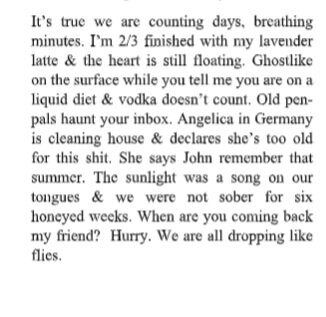
The Plastic Bag Will Not Fully Inflate
by Beth Gordon
--
Background reading and writing music.
The Plastic Bag Will Not Fully Inflate
by Beth Gordon
Originally published in The Hunger Issue 8, I think this would technically be a bit more of a prose poem, or just poem than microfiction, but seeing as I'm in charge here, and there aren't line-breaks just changes to the margins of the piece, I think it fits. I love the bittersweet reminiscences of this piece, the straightforward wording is still very interesting and voicey. Big fan of this author.
In their words: "The Hunger is a journal of visceral writing that publishes fiction, poetry, nonfiction, hybrid work, and visual art... [they want] writing that guts you, that makes you howl with its honesty, that leaves you bloodied, raw, and hungering for more. The Hunger is looking for the lyrical, the strange, the uncomfortable, the vulnerable, the mangled monsters inside." About the Author: Beth Gordon is a poet, mother and grandmother currently living Asheville, NC. Her poems have been published in numerous journals and nominated for Best of the Net, Pushcart and the Orison Anthology. She is the author of the chapbook, Morning Walk with Dead Possum, Breakfast and Parallel Universe (Animal Heart Press) and the chapbook, Particularly Dangerous Situation, (Clare Songbird Publishing). She is Poetry Editor of Gone Lawn and Assistant Editor of Animal Heart Press.
Potential exercise: Write a piece from a somewhat older adult's perspective in which they're recalling old friends by first name very briefly, moving on quickly. Try to imbue your piece with the sense of slow urgency, an ominousness such as Beth Gordon's piece has. Kicker? Include as the penultimate sentence the same one word as in "The Plastic Bag Will Not Fully Inflate".
--
Background reading and writing music.


